How will tactical voting affect Gorton and Denton?
New YouGov data on tactical voting willingness, applied to our MRP projection, suggests the Green squeeze on Labour could be the decisive factor next week.
Our previous article covered what a demographic model suggests could happen in Gorton & Denton as a three-way fight: Green 27%, Reform 27%, Labour 23%.
A margin that thin means tactical voting could easily swing the result. So who’s willing to lend their vote - and to whom?
New YouGov research published today gives us the most detailed picture yet of the tactical voting landscape heading into 2026. Here’s what it could mean for Gorton & Denton.
The Tactical Maths
Our model gives five parties meaningful vote shares:
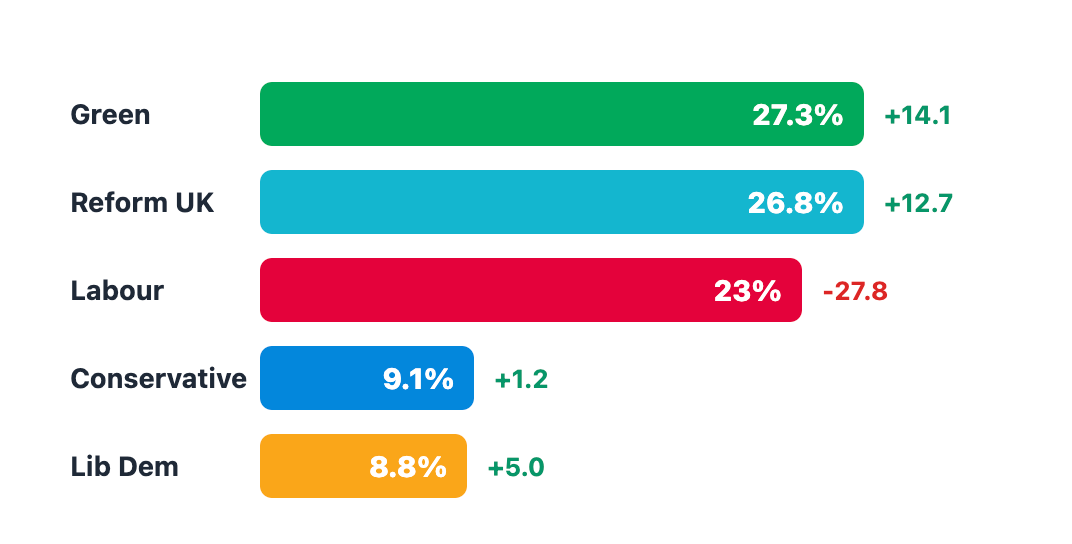
The question is what happens to the ~41% currently voting Labour, the Conservatives and the Lib Dems. In a Green vs Reform fight, do they pick a side?
What YouGov Tells Us
YouGov tested voter behaviour in every two-party scenario. The Green vs Reform matchup is one of the most lopsided: voters back the Greens 42% to 27% when told only those two can win.
The real intrigue is in the party by party breakdown though:
Labour voters (23% of our projection): The most enthusiastic tactical voters in the country. 77% say they’d switch to the Greens to stop Reform winning their seat. In Gorton & Denton, where Labour currently seems to have no realistic path to winning, the squeeze potential is enormous. If even half of Labour’s projected 23% switches Green, that’s +11 points.
Lib Dem voters (8.8%): 73% would switch to Green if they were the only realistic challenger to Reform. That’s potentially +6 points to the Greens.
Conservative voters (9.1%): This is one of the only positives for Reform, although it’s not all good. 24% of Tory voters say they’d back the Greens to stop Reform. Meanwhile, 37-41% of Conservatives would back Reform against progressive parties, sending ~3-4 points to Goodwin.
Reform voters: The most loyal. 37-41% would stick with Reform even if the Conservatives were the only viable alternative. In Gorton & Denton, where the fight is against the Greens rather than the Tories, Reform’s vote is likely to be very solid.
The Squeeze Scenario
If tactical voting plays out at the rates YouGov finds nationally, the effect in Gorton & Denton could be significant:
This shows the best case scenario for each party - in the unlikely event that 77% of Labour voters backed Green, it’d be a blowout.
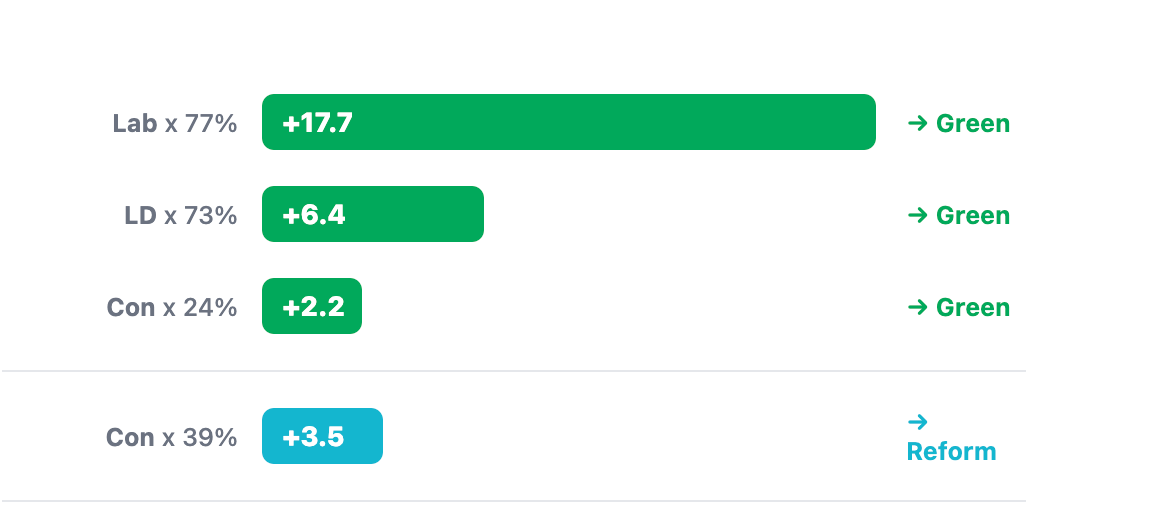
30% of Labour voters say they’d back the Tories to stop Reform - but that only applies if the Tories are the challenger. In Gorton & Denton, they aren’t.
Of course, these rates are maximums. Not every voter who says they’d vote tactically in a YouGov survey will actually do it at the ballot box. By-election turnout is lower, information about who can win is imperfect, and some voters will stick with their party out of habit. However, at the same time, tactical voting could be even higher in a high profile and divisive by-election race.
But the direction is clear: the tactical pool favours the Greens over Reform in this seat.
Why This Makes Reform’s Path Harder
Reform’s problem isn’t their own voters - those are solid. It’s that they have almost no tactical reserve to draw from. Currently, they look to be close to their ceiling in this constituency.
The Greens however have a deep well of potential tactical support from Labour, Lib Dem, and even some Conservative voters. The question is whether enough of that potential converts into actual votes.
The big unknown is whether Labour voters in Gorton & Denton will actually decide to tactically vote and so squeeze Reform. By-elections often see tactical voting intensify in the final week, as local messaging and tactical voting sites hammer the “only the Greens can stop Reform here” line. If that message lands, the tactical vote could be decisive.
What to Watch on the Night
Labour’s final vote share is the key indicator. If Labour finishes below 20%, the tactical squeeze worked and Green likely wins comfortably. If Labour holds above 25%, the squeeze failed and Reform has a genuine shot.
Conservative share tells us about right-wing tactical voting. If Conservatives drop below 5%, significant Tory-to-Reform tactical voting occurred. If they hold 8-9%, the anti-Reform Tory tactical vote may have partially offset it.
Turnout. By-elections typically favour motivated insurgents. Reform’s voters came out in Runcorn and Helsby. The Greens are as yet untested in a high profile by-election and are relying on a larger and more varied coalition of voters than Reform.
The biggest question is if voters will decide that only one party can stop Reform. If they do, and that party is the Greens, they will almost certainly win. If voters can’t decide between Labour and Greens, then Reform have a chance to come down the middle
*Tactical voting data from YouGov, fieldwork February 2026. The tactical scenarios described are illustrative - they apply national rates to a single constituency and assume voters have perfect information about which parties are competitive locally.